Auto Shop.
Estimates to invoices to payment — service-writer-friendly processing for auto repair.
Built For You, Configured By Us.
Text-to-pay gets tickets paid before pickup; card-on-file handles fleet accounts; financing options close big repairs.
Integrates alongside your shop management system.
- ★Invoicing & card-on-file billingSend invoices with pay links, store cards on file for repeat accounts, and automate recurring billing — so your A/R stops being a part-time job.
- ★Mobile payments in the fieldTap-to-pay on a phone, Bluetooth readers, and text-to-pay get you paid on-site instead of invoicing after the fact and waiting weeks to collect.
- ★Appointment & dispatch friendlyPayment tools that fit how service businesses actually run — deposits at booking, balances at completion, and card-on-file for standing appointments.
- ★Next-day or same day fundingFast funding smooths the cash-flow gap between doing the work and getting paid, so payroll and materials never wait on a slow settlement.
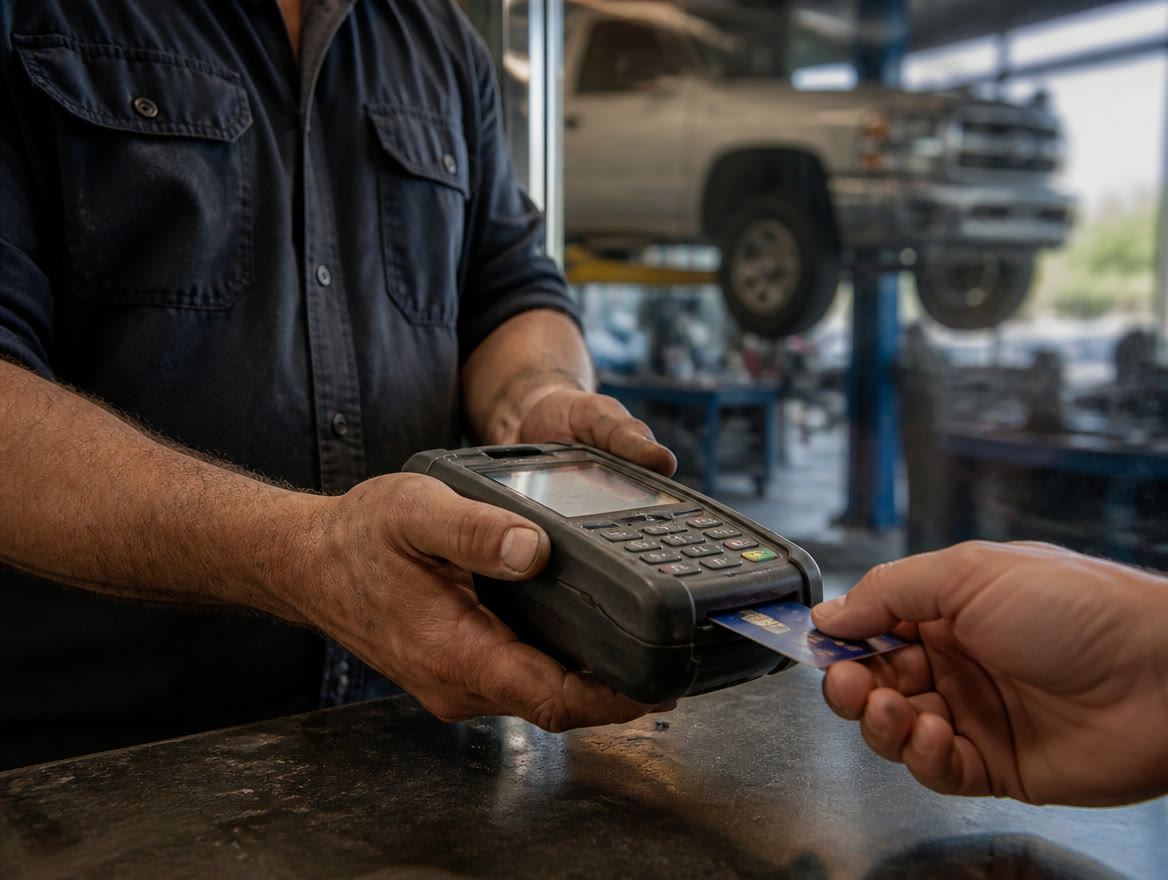
What It’s Really Like To Run A Auto Shop.
Your service writer opens the bay doors at 7:30 and the ROs start stacking — an alternator, a brake job, a check-engine mystery that turns into a $2,400 head gasket. Every repair order means a phone call for approval, parts ordered from the counter, and a customer who needs the car back by Friday. You’re quoting labor hours, juggling loaner keys, and hoping the parts markup covers the tech who called in sick. The counter is where the whole day gets settled, one signature at a time.
Then the ticket hits the terminal. A $2,400 repair on a rewards card costs you $70 or more in processing before you’ve paid the tech. Customers approve work by phone, so cards get keyed in at penalty rates. Fleet accounts want invoices and pay in 45 days. And when a customer disputes a repair two months later, the chargeback lands on you with a stack of paperwork. Margins on parts are thin enough — the card fees come straight out of labor.
On a $2,400 repair order, standard card processing can cost more than an hour of your posted labor rate — dual pricing puts that hour back on your side of the counter.
Where Payments Hurt
- ★3% card fees on big repair tickets come straight out of labor margin.
- ★Phone approvals mean keyed-in cards at higher card-not-present rates.
- ★Fleet and warranty accounts pay by invoice, 30 to 45 days late.
- ★Chargebacks months after a repair, with the burden of proof on you.
How Lone Star Fixes It
- ★Texas dual pricing on a Clover or Dejavoo terminal — card price and cash price shown on every RO. See how dual pricing works.
- ★Text-to-pay links for phone approvals so remote payments run as secure customer-entered transactions, not keyed-in cards.
- ★ACH invoicing for fleet accounts with automatic reminders through Biller Genie.
- ★Same day funding so Friday’s tickets cover Saturday’s parts orders, plus up to $5,000 toward a POS upgrade.
Auto Shop Owners Ask Us
Is dual pricing legal for auto repair shops in Texas?
Yes. Texas allows dual pricing when the card price and cash price are both clearly posted, which is different from surcharging. As a Dallas / Ft. Worth-based processor we set up the signage, receipts, and terminal programming so your shop stays compliant.
How do I take payment when a customer approves a repair by phone?
Send a text-to-pay link instead of keying the card at the counter. The customer enters their own card on a secure page, which protects you on disputes and typically processes at a better rate than a hand-keyed transaction.
Can I get my money the same day I close out?
With same day funding, batches closed before the cutoff hit your bank the same business day — including weekends on eligible programs. That matters when parts suppliers want payment before the car leaves the lift.
Explore Services
Ready To See It In Action?
Call (214) 838-1818 and a specialist will walk you through the right setup for your business — and ask about up to $5,000 to upgrade your POS.